
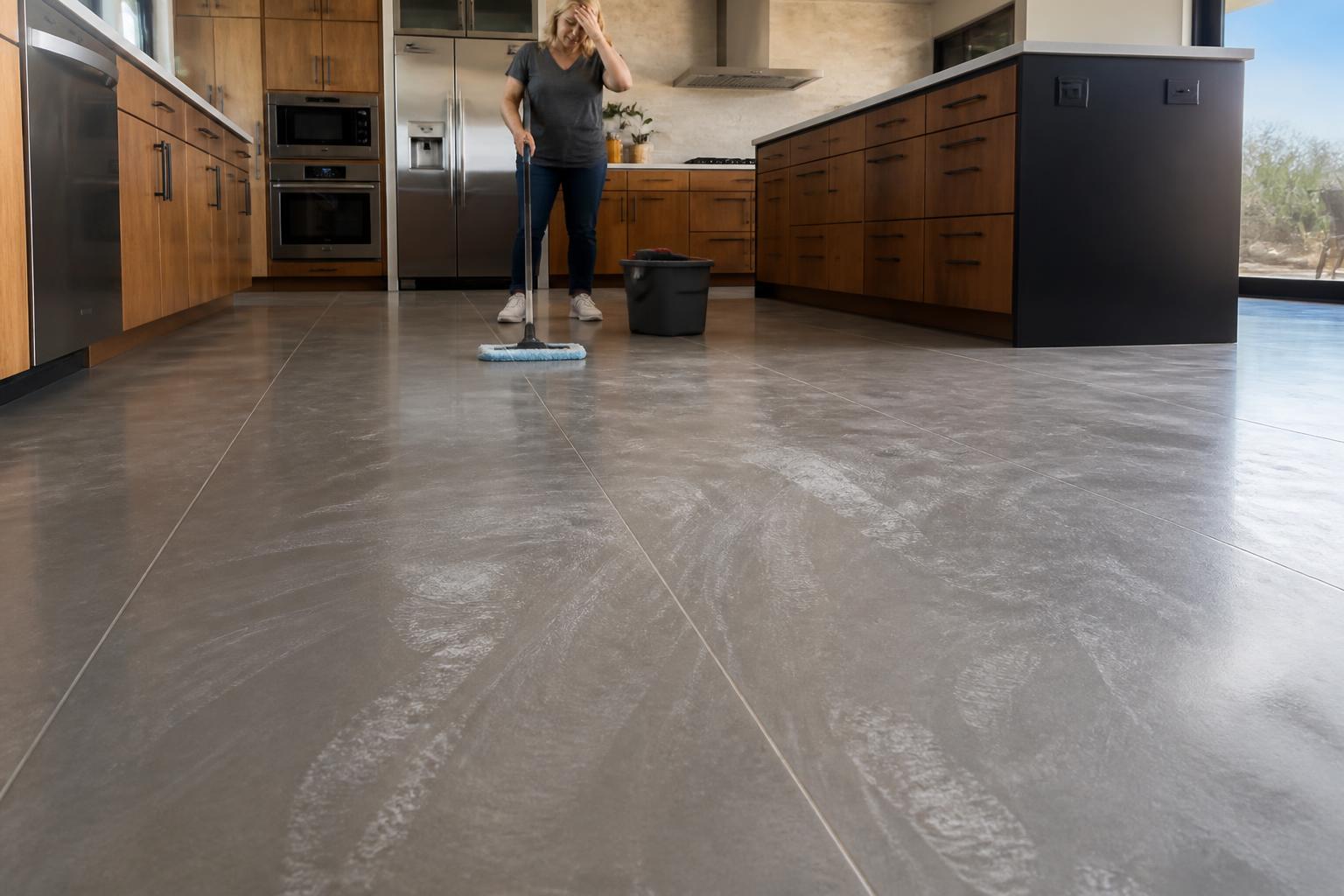
You just mopped. The floor looked perfect for 45 minutes. Now the sunlight is hitting it and you can count every streak, every footprint, and every cloudy patch where the mop dragged. Every Arizona homeowner with modern porcelain, especially large format matte or textured wood-look, has lived this exact frustration. The truth is that these floors are not designed to be cleaned with a mop and bucket, and no amount of scrubbing will fix what a mop is actively making worse.
Why modern porcelain resists mopping
Twenty years ago, porcelain floors had a slick glazed surface that wiped clean because there was nowhere for soil to hide. The porcelain in your Arizona home today is engineered completely differently, and that engineering is exactly why the mop fails.
- Micro-texture: matte and textured porcelain has thousands of microscopic peaks and valleys per square inch designed for slip resistance. Mop fibers ride the peaks and leave the valleys full of dirty water.
- Large format seams: 24 by 48 inch and larger tiles have fewer grout lines but the ones they have are wider and lower than the tile face, so mop water pools there and evaporates as a grey rim.
- Rectified sharp edges: modern porcelain has knife-sharp edges that shred mop fibers, leaving microfilament residue behind.
- Anti-slip coefficient of friction (COF) treatments: many builder-installed porcelains have a factory anti-slip finish that is chemically bonded to hold onto anything wet, including your mop water.
- Hard water in the mop bucket: Arizona water is 12 to 25 grains hard. Every mop stroke deposits calcium film that dries to a cloudy haze.
Every time you mop textured porcelain with a string mop or sponge mop and tap water, you are depositing more residue than you are removing. The floor gets progressively worse, not cleaner.
The residue cycle no product can escape
Here is what actually happens when you mop textured porcelain in Arizona. You dip the mop, wring it out, and drag it across the floor. The peaks get wiped clean. The valleys collect a mix of mop water, cleaner, hard water minerals, and the last mop's leftover soil. As the floor dries, the water evaporates and leaves that mixture behind as a chalky film. You look at the floor, see streaks, and mop again with a slightly dirtier mop and slightly harder-mineral water. The cycle repeats every week. After 18 months the floor has a permanent grey cast that no mop can lift.
What actually cleans porcelain
The only way to reliably clean textured or large-format porcelain is to lift the soil out of the micro-texture with physical agitation and extract it from the surface before it can dry back down. Mops cannot do either of those things. Truck-mounted hot-water extraction can. Here is the professional process we use at Lazona.
- Pre-treat with an alkaline emulsifier tuned for calcium and organic soil, 8 to 10 minute dwell.
- Agitate with a counter-rotating brush machine to physically dislodge residue from every valley in the texture.
- Rinse and extract at 220 degrees Fahrenheit and 500 PSI, which flash-vaporizes hard water film and vacuums the soil off the floor before it can re-deposit.
- Second pass with a neutral rinse to prevent alkaline residue.
- Air move and inspect under raking light.
One professional deep clean removes 3 to 10 years of embedded mop residue in a single visit. Homes look brighter by 2 to 3 shades and cleaning becomes dramatically easier because the micro-texture is finally empty again.
The one-time fix: densification and topical seal
After the deep clean, the highest-value upgrade you can make to a porcelain floor is a professional densifier and topical seal. The densifier reacts chemically with the porcelain to fill the micro-porosity of the surface. The topical seal creates a thin non-porous layer that mops can actually clean. Together they transform a floor that was impossible to mop into a floor that wipes clean with plain water and a microfiber.
| Metric | Before | After Lazona |
|---|---|---|
| Weekly mop time | 35 to 55 min | 8 to 12 min |
| Streaks after drying | Constant | None |
| Cloudy film buildup | Weekly | Eliminated |
| Footprint visibility | High | Minimal |
| Cleaner required | Multiple products | Water and microfiber |
How to mop between professional visits
- Use a flat microfiber mop, not string or sponge. Replace the pad every 400 sq ft.
- Use distilled or filtered water in Arizona. Tap water is the single biggest cause of hard water film.
- Skip the cleaner most weeks. A damp microfiber pulls more soil than a wet chemical pass.
- When you do use a cleaner, use a neutral pH product designed for porcelain. Avoid vinegar, bleach, and ammonia.
- Dry immediately in high-humidity months with a second dry microfiber pass.
If you are pouring cleaner in the mop bucket, you are almost certainly using 4 to 8 times the dose the manufacturer recommends. Over-dosing is the number one cause of residue on porcelain.
Cost of professional porcelain restoration in Arizona
| Area | Deep Clean Only | Deep Clean + Seal | Result Duration |
|---|---|---|---|
| Up to 400 sq ft | $425 | $795 | 18 to 24 months |
| 400 to 900 sq ft | $650 | $1,290 | 18 to 24 months |
| 900 to 1,600 sq ft | $975 | $1,890 | 18 to 24 months |
| 1,600 to 2,600 sq ft | $1,350 | $2,650 | 18 to 24 months |
All porcelain restoration work is covered under the Lazona 15-Year Warranty for the color-sealed grout and a 2-year performance warranty on the porcelain topical seal. If the tile stains through the seal or the seal fails, we return and re-treat.
Book your porcelain rescue
Stop fighting your floor. Call 480-352-0392 or book a consultation and we will send a specialist to test-clean a section of your porcelain in your home so you can see the result before you commit.