
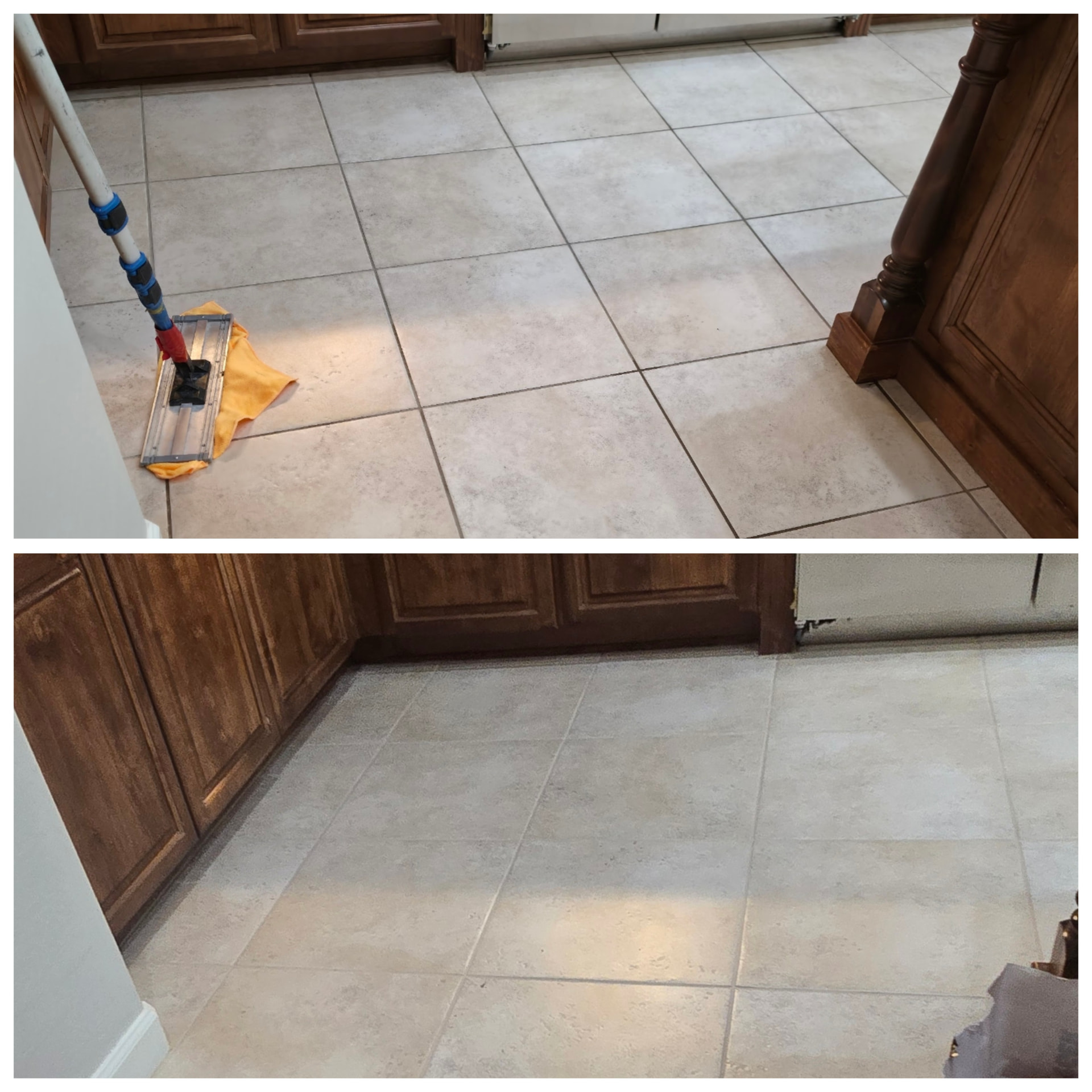
This Las Sendas home in Mesa sold in early summer, and the new owners did the smart thing: they had the floors restored before a single box came off the truck. The porcelain tile throughout the kitchen, entry, and hallways looked hazy and gray no matter how recently it had been mopped, and the grout had gone from a light sand color to a mottled, blotchy gray. Nothing was wrong with the tile itself. The problem was years of mop water, detergent film, and Arizona hard water minerals sitting in and on a surface that a household mop physically cannot reach.
Why This Porcelain Floor Would Not Mop Clean
Porcelain is the least porous floor tile in common use. That is a good thing, but it creates a specific failure mode in Arizona homes. Because water cannot soak into porcelain, everything a mop leaves behind stays on top of it: soap surfactants, floor cleaner polymers, calcium and magnesium from our hard water, and the fine dust that comes through every East Valley door. Each pass of a mop redeposits a thin layer of that slurry, it dries, and the next pass adds another. Within a few years the surface reads as dull, gray, and slightly sticky underfoot even the day after cleaning.
- Mop water is dirty water. On porcelain it dries in place instead of absorbing, so the film builds instead of disappearing
- Consumer floor cleaners contain gloss agents and polymers that intentionally leave residue behind
- Mesa hard water deposits calcium directly onto the tile face and into the grout joint as it evaporates
- Grout is porous even when the tile is not, so the joint absorbs the same dirty water the tile repels
- Once grout absorbs stain below the surface, no amount of cleaning restores original color
If your porcelain floor looks worse right after mopping than it did before, you are not imagining it. You are looking at detergent and mineral film, not dirt, and it takes a professional rinse and extraction to strip it off.
What We Found on the Walkthrough
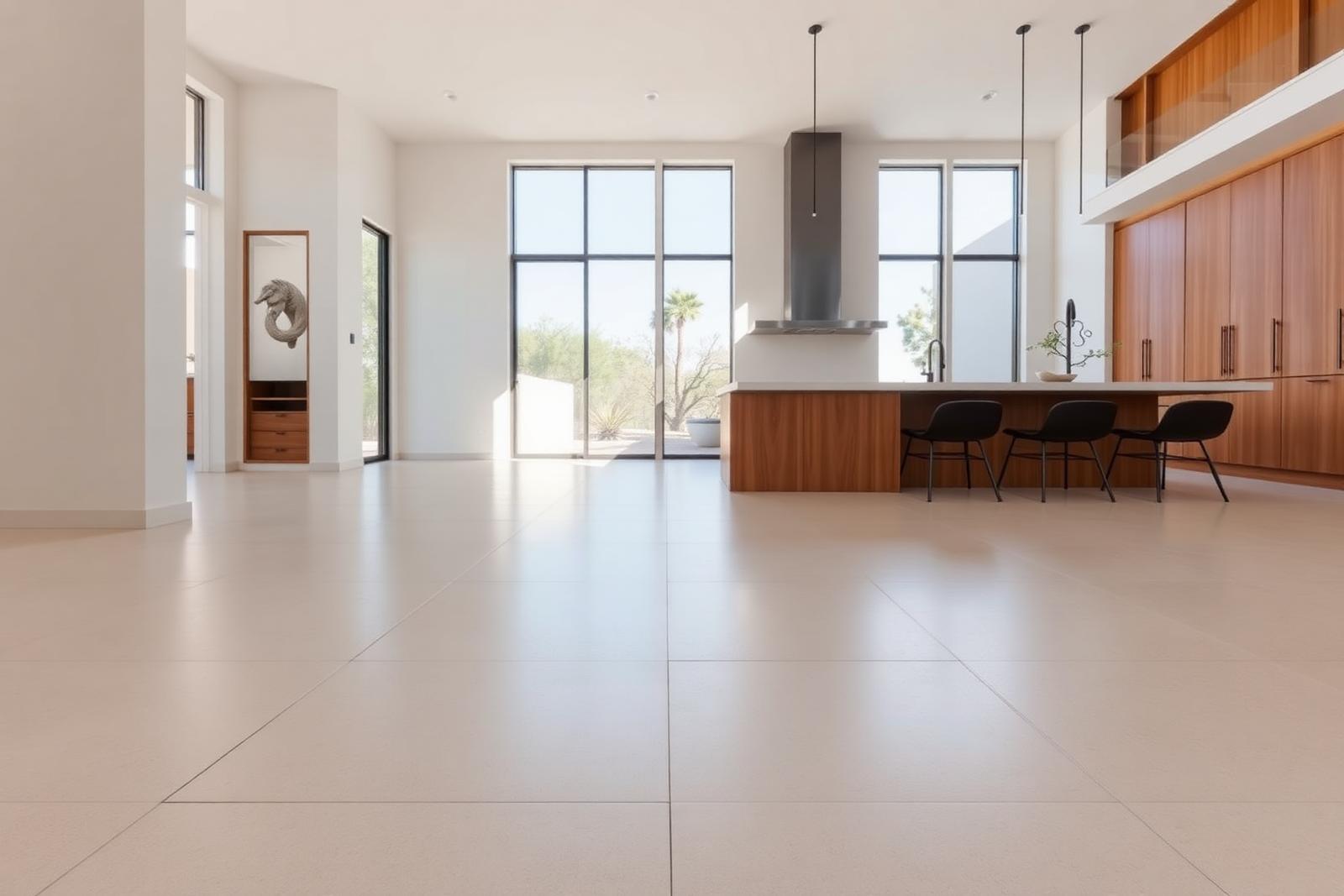
Las Sendas homes tend to be well built, and this one was no exception. The tile was sound, the substrate was solid, and there were no hollow spots or cracked pieces to repair. What we documented instead was cosmetic and chemical: heavy surfactant haze on the tile face, calcium film along the traffic lanes, grout joints stained unevenly from light sand to charcoal gray, and a handful of joints along the kitchen island that had eroded slightly from years of acidic cleaner use.
- Detergent and gloss-agent film across the entire tile surface
- Hard water calcium concentrated in front of the sink and along the entry path
- Grout discolored unevenly, darkest in the kitchen and hallway traffic lanes
- Minor grout erosion and pinholes near the island from past acidic cleaners
- No structural repairs required, no cracked or hollow tile
The Restoration We Performed
The order of operations matters more than the products. We strip the film first, then address the grout, then protect the result. Skipping straight to sealing on a floor like this locks the haze in permanently, which is exactly what happens when a general cleaning company applies a clear sealer over an unstripped floor.
- Dry soil removal and full protection of baseboards, cabinet toe kicks, and door casings
- Alkaline film-stripping pre-treatment with dwell time to break the surfactant and polymer layer
- Mechanical agitation on tile and joints with the correct brush for porcelain, no abrasive pads
- Truck-mounted hot water extraction at high pressure with contained recovery, so no dirty water is left on the floor
- Neutral pH rinse and a second extraction pass to remove all residue and reset the surface pH
- Minor grout joint repair at the island where past cleaners had opened pinholes
- Full dry-down, then grout color sealing across every linear inch of joint in a single matched color
- Final inspection with the client, plus written aftercare so the floor is never mopped with the wrong product again
Why We Color Sealed Instead of Applying a Clear Sealer
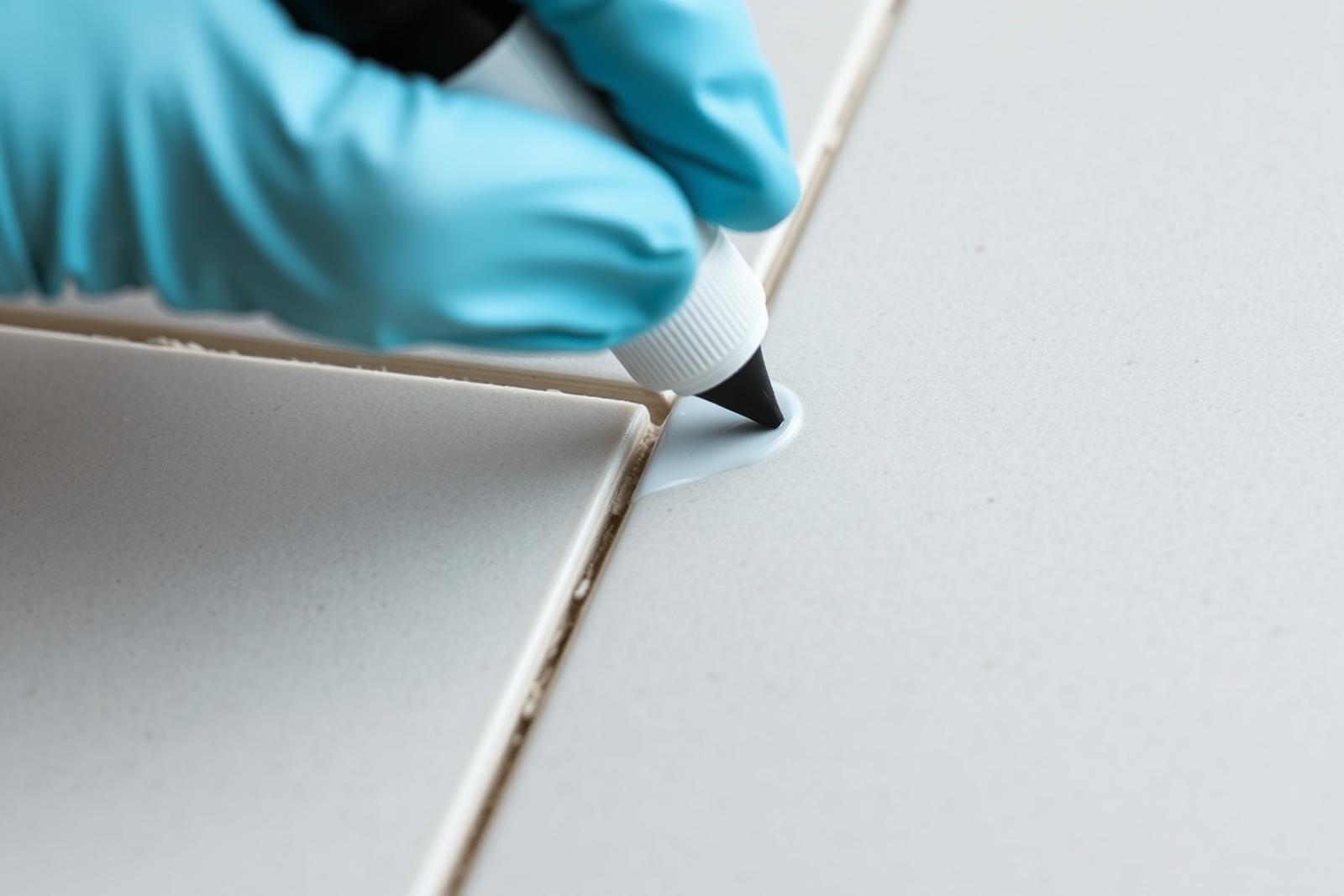
Here is the analogy we give every homeowner. When you get a stain on a white shirt and run it through the wash, the shirt comes out clean. It is still stained. Grout works the same way. Cleaning sanitizes the joint and removes what sits on top, but the pigment that has absorbed into the cement is not coming out. Restoring uniform color means adding color back, and that is what a color seal does. It pigments the joint and caps it in the same application, so the joint is both uniform and sealed against future absorption.
A clear penetrating sealer, by contrast, does nothing for existing discoloration and wears off with mop traffic. That is the cycle most homeowners get stuck in: pay for cleaning and a clear seal, watch it mop away over a year or two, pay again, and never actually get a floor that looks uniform. Color sealing breaks that cycle, and ours is backed by our 15-Year Warranty, which is why our clients never pay to seal their grout again.
| Outcome | Cleaning + Clear Sealer | Restoration + Color Seal |
|---|---|---|
| Removes surface soil and film | Yes | Yes |
| Restores uniform grout color | No | Yes |
| Blocks future staining in the joint | Temporarily | Yes, sealed and pigmented |
| Survives regular mopping | Wears off in 1 to 2 years | Holds long term |
| Fixes pinholes and eroded joints | No | Repaired first, then sealed |
| Warranty | None or short term | 15-Year Warranty |
| Long-term cost | Repeats every 1 to 2 years | Done once |
Be careful with companies that flood a tile floor and rely on baseboard contact. Saturated MDF baseboards swell and separate from the wall, and that damage is not reversible with cleaning. We mask and protect every vertical surface before any water touches the floor.
Why Pre Move-In Is the Best Time to Do This
An empty house is the ideal job site. There is no furniture to work around, no rugs to lift, no schedule to negotiate around a family, and no risk of a pet walking through a curing color seal. We can run the entire floor in one continuous pass, which produces a more uniform result than working room by room around a lived-in home. For buyers in Las Sendas, Red Mountain Ranch, Mountain Bridge, and the rest of northeast Mesa, the window between closing and the moving truck is the single easiest time to reset a floor for the next decade.
- One continuous pass across the whole floor for the most uniform color
- No furniture moving fees and no rooms skipped
- Full cure time with zero foot traffic, which strengthens the seal
- You move into a floor that is already sealed and protected on day one
- Any grout repairs get done before rugs and furniture hide them
"The tile was never the problem. Ten years of mop water was. Strip it, repair it, color seal it once, and the floor stops being a chore."
Porcelain Floor Restoration Across Mesa and the East Valley
We restore porcelain, ceramic, travertine, and natural stone floors throughout Mesa, Chandler, Gilbert, Tempe, Ahwatukee, Scottsdale, and Paradise Valley. Tile and grout cleaning starts at $1.00 per square foot, and grout color sealing carries a $750 minimum with a 15-Year Warranty on the seal. If your porcelain floor has stopped responding to mopping, or you just closed on a home in northeast Mesa and want it handled before move-in, call 480-352-0392 and we will give you honest pricing and a straight answer about what the floor actually needs.