
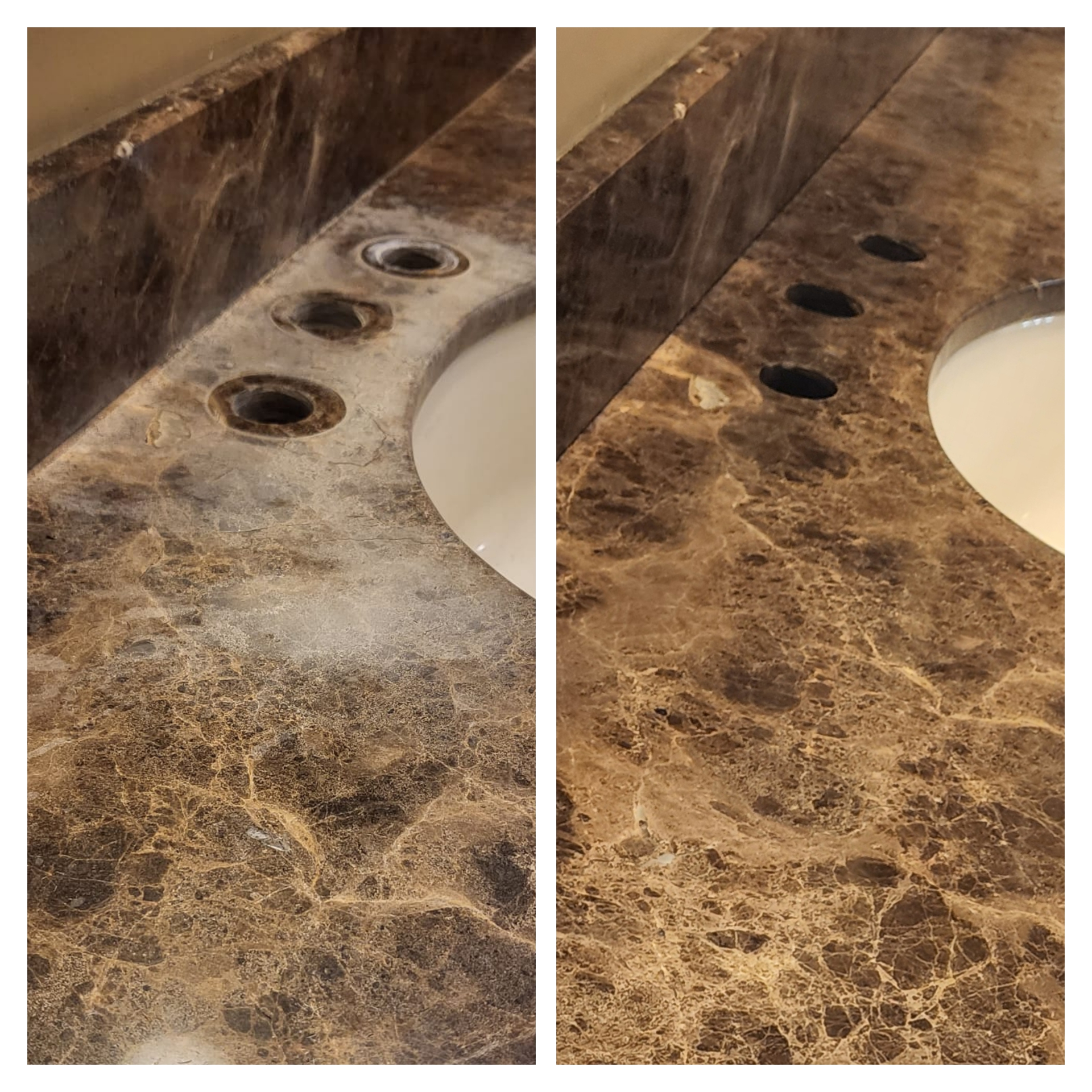
You invested thousands in beautiful stone countertops. Now they look tired: dull surfaces, ring marks around the faucet, oil stains that will not come out, and small pits and chips accumulating over time. The knee-jerk reaction is to start shopping for replacement slabs. But here is what contractors will not tell you: most damaged countertops can be restored to like-new condition for 75-85% less than replacement cost. The same restoration vs replacement math applies to floors and showers, and our breakdown of tile restoration vs replacement for Gilbert homeowners walks through it in detail. Also see our tile restoration vs replacement.
Why Stone Countertops Lose Their Luster
Natural stone countertops do not simply 'wear out.' They deteriorate due to specific causes, most of which are completely reversible with professional restoration.
- Surface erosion from acidic substances (citrus, wine, tomatoes, coffee)
- Chemical etching from harsh cleaners and bathroom products
- Oil absorption from cooking oils, lotions, and beauty products
- Mineral deposits from hard water around faucets and sinks
- Mechanical abrasion from daily use and improper cleaning
- UV degradation in outdoor or high-sunlight areas
- Sealer breakdown leaving stone unprotected and vulnerable
The Faucet Zone: Why Damage Concentrates Here
The area around kitchen and bathroom faucets takes the worst abuse. This is where water sits repeatedly, where hands rest while washing, and where cleaning products accumulate. In Arizona, our extremely hard water accelerates damage in these zones.
- Hard water deposits etch into stone as minerals dry on the surface
- Soap and lotion residue creates a film that attracts dirt
- Repeated wiping wears through the polish faster than other areas
- Water pooling breaks down sealer, leaving stone vulnerable
- Beauty products (perfume, hairspray, lotion) contain acids that etch marble
The dull, rough ring around your faucet is not a stain. It is physical erosion of the stone's polished surface. It cannot be cleaned away but can be mechanically re-polished.
Understanding Stone Damage Types
Different types of damage require different restoration approaches. Knowing what you are dealing with helps set realistic expectations.
- Etching: Dull spots from acid contact. Affects marble, limestone, travertine most. Requires honing and polishing to remove.
- Staining: Discoloration from absorbed substances like oil, wine, rust. Requires poulticing to draw out the contaminant.
- Scratching: Surface abrasions from abrasive materials. Requires honing at appropriate grit levels.
- Pitting: Small holes from wear or soft mineral inclusions. Can be filled with color-matched epoxy.
- Spalling: Flaking or chipping of the surface. Requires repair with stone-appropriate materials.
- Water rings: Circular marks from moisture. Usually etching or mineral deposits, treated accordingly.
Oil Stains: The Kitchen Countertop Curse
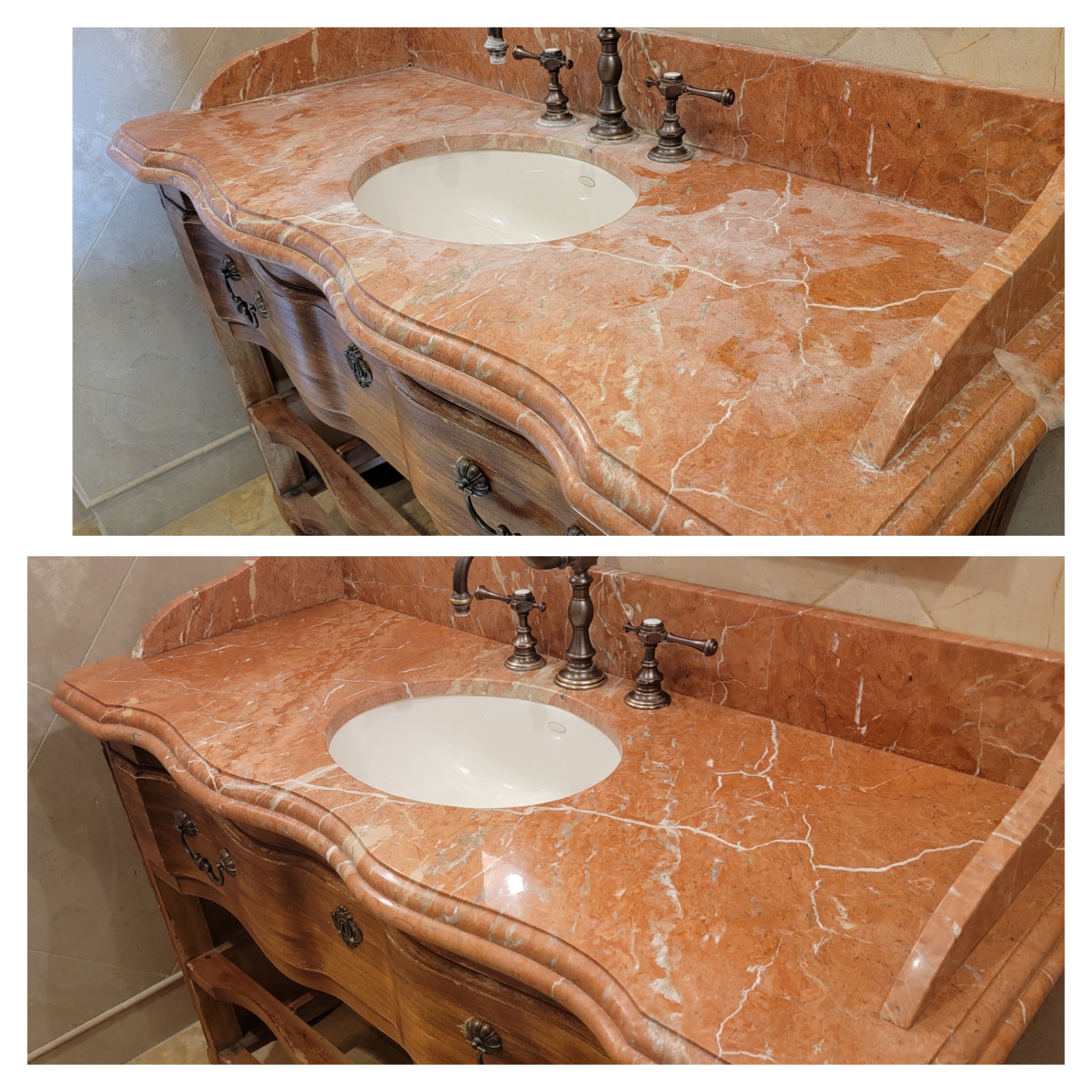
Granite and other natural stones are porous. Without proper sealing, cooking oils penetrate the surface and create dark, spreading stains that worsen over time. Even sealed stone can absorb oils if the sealer has degraded.
Oil stain removal requires professional poulticing: applying a drawing agent that pulls the oil out of the stone over 24-48 hours. Multiple applications may be necessary for deep stains. Once removed, proper sealing prevents recurrence.
Do not try to remove oil stains with bleach, ammonia, or acidic cleaners. These products can set the stain permanently and cause additional damage to the stone surface.
Spalling and Pitting: Wear and Tear Reality
Over years of use, stone countertops develop small pits, chips, and areas where the surface is flaking. This is especially common in high-traffic zones near the stove, sink, and food prep areas.
Professional restoration addresses these issues with epoxy filling, color matching, and surface honing to blend repairs seamlessly. The result is a smooth, uniform surface that looks new.
The Real Cost: Restoration vs. Replacement
This is the information that changes minds. When you understand the actual cost difference, restoration becomes the obvious choice for most situations.
- New granite countertops (material + fabrication + installation): $3,000-$8,000
- New marble countertops: $4,000-$12,000
- New quartzite countertops: $5,000-$15,000
- Demolition and disposal of existing counters: $500-$1,500
- Potential cabinet damage during removal: $500-$2,000+
- Plumbing disconnect and reconnect: $300-$800
- Total replacement cost: $8,000-$30,000+
Now compare restoration costs:
- Professional countertop restoration (honing, polishing, sealing): $800-$2,500
- Stain removal (poulticing): $200-$500 per stain area
- Chip and pit repair: $150-$400 per area
- Complete kitchen countertop restoration: $1,500-$4,000
- Complete bathroom vanity restoration: $800-$1,500
- Total restoration cost: 75-85% less than replacement
Restoration takes 1-2 days with minimal disruption. Replacement takes weeks, requires temporary countertops, and creates significant construction debris in your home.
What Professional Countertop Restoration Includes
Comprehensive countertop restoration is a multi-step process that addresses all forms of damage and leaves the stone protected for years to come.
- Deep cleaning to remove surface contaminants and residues
- Poulticing to extract deep oil and organic stains
- Honing with progressive diamond abrasives to remove etching and scratches
- Polishing to restore the original shine and depth
- Chip and pit repair with color-matched materials
- Seam repair and re-caulking if needed
- Professional-grade impregnating sealer application
- Edge restoration and detail polishing
Marble Countertops: Special Considerations
Marble is calcium-based stone that etches instantly upon contact with any acidic substance. Lemon juice, wine, tomato sauce, coffee, and even some tap water will leave dull spots. This is normal marble behavior, not a defect.
Marble countertop restoration requires understanding that etching will occur again with use. The goal is to restore the surface and protect it with appropriate sealers, then educate homeowners on preventing future damage.
- Use cutting boards and trivets religiously
- Wipe spills immediately, especially acidic substances
- Use coasters under all glasses
- Apply impregnating sealer annually or as recommended
- Consider anti-etch topical sealers for added protection
- Accept that some patina is part of marble's living character
Granite Countertops: Tougher But Not Invincible
Granite is more resistant to etching than marble but still vulnerable to staining, dulling from harsh cleaners, and surface wear. Many 'granite' countertops are actually other stones like gabbro or anorthosite, which may behave differently.
Granite restoration focuses on removing surface contamination, restoring depth and shine through polishing, and applying proper sealer. Most granite can be restored to better-than-original appearance.
When Replacement Actually Makes Sense
Restoration is not always the answer. Here are situations where replacement may be the better choice:
- Large cracks that compromise structural integrity
- Severe warping or movement from water damage underneath
- Stone that was installed with poor quality material
- Complete style change where current stone does not fit new design
- Damage covering more than 50% of the surface area
- Stone types that cannot be effectively restored (some engineered materials)
Even in borderline cases, professional assessment can identify options you might not know exist. We have restored countertops that homeowners assumed were beyond saving.
Maintenance After Restoration
Protecting your investment means adopting proper maintenance habits. The goal is to keep the stone sealed and avoid the substances that caused damage in the first place.
- Clean with pH-neutral stone soap only, never vinegar or citrus cleaners
- Wipe up spills immediately, especially wine, citrus, and coffee
- Use cutting boards, trivets, and coasters consistently
- Reseal every 1-3 years or when water stops beading on the surface
- Avoid sitting or standing on countertops (stress can cause cracks)
- Do not use the countertop as a cutting surface
A small bottle of pH-neutral stone cleaner costs under $20 and lasts months. Harsh cleaners cost similar amounts but destroy your countertops. The choice is obvious.
Arizona-Specific Countertop Challenges
Arizona homeowners face unique challenges that accelerate countertop degradation:
- Extreme hard water leaves mineral deposits that etch stone over time
- Low humidity can affect some stone types and existing repairs
- High UV exposure near windows causes color fading in some stones
- Dust and fine particles act as abrasives during cleaning
- Air conditioning condensation can cause water rings if dripping on counters
Making the Right Choice
Before committing to a $10,000-$30,000 replacement project, get a professional restoration assessment. In most cases, your existing countertops can be brought back to beautiful condition for a fraction of the cost, in a fraction of the time, with a fraction of the disruption.
For professional countertop assessment and restoration in the Phoenix metro area, contact Lazona Tile Care at mbstonecare.com. We specialize in restoring natural stone surfaces to their original beauty.