
A mark disappearing is not the same as a finish being preserved. On polished stone, an abrasive cleaning pad can change how light reflects. The product maker warns against polished surfaces, but a photograph alone cannot tell us whether a dull patch came from abrasion, acid or removable film.
Start with the finish, not the stain
A polished countertop works like a collection of tiny reflecting surfaces. A clean but uneven finish scatters light instead of returning a sharp reflection. That is why the useful question is not simply “Did the mark come off?” It is “Does this dry area still match the surrounding sheen?” A honed finish is lower-sheen by design; it is not dirty merely because it lacks a mirror reflection.
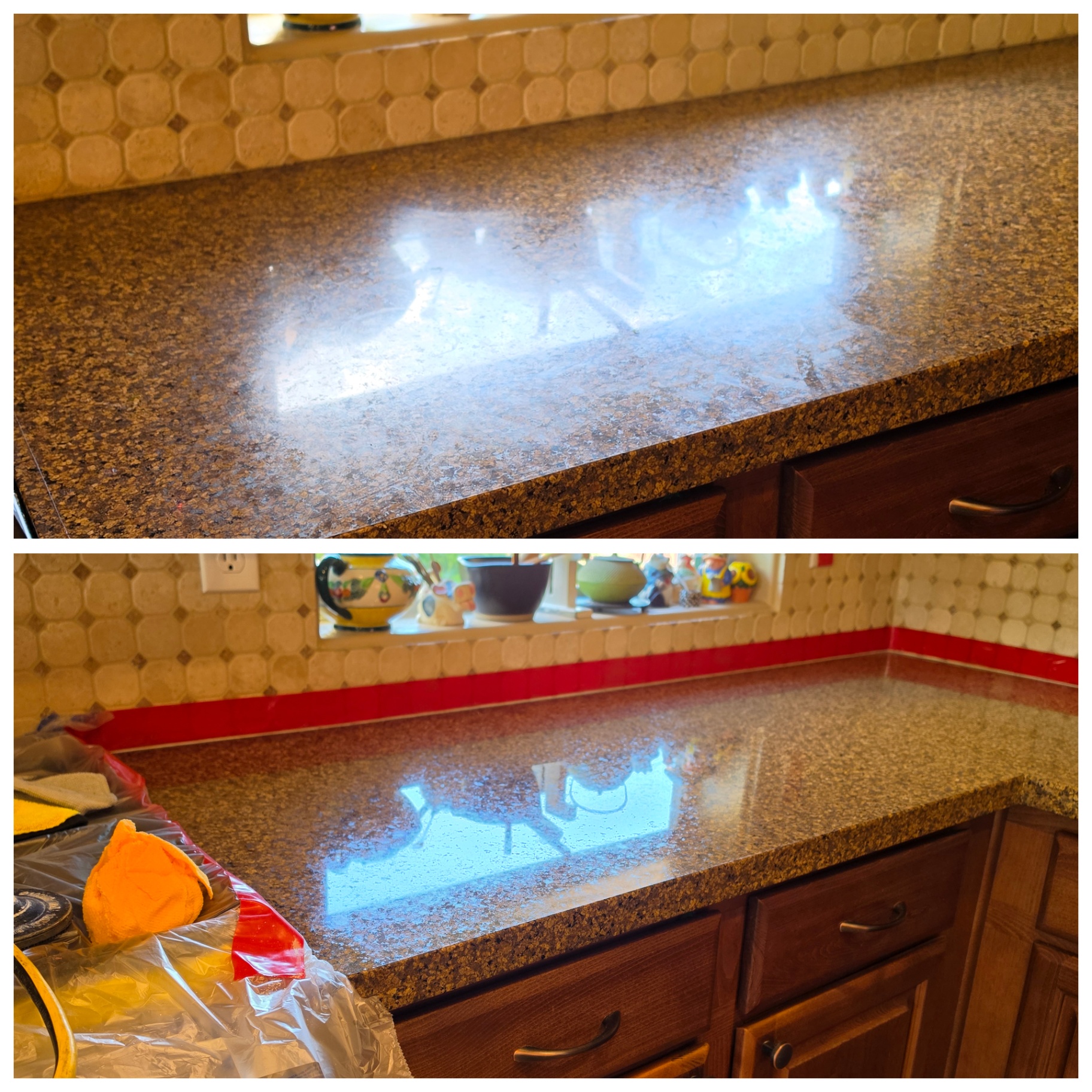
What the manufacturer actually says
Mr. Clean describes Magic Eraser cleaning in terms of micro-scrubbers. Its guidance says to test a small area with light pressure and does not recommend the product on high-gloss or polished surfaces. The same guidance says not to use it with chlorine bleach or other household cleaners. Those are product warnings, not a claim that a particular countertop will be ruined after one wipe.
| Question | What we can substantiate | What we cannot infer |
|---|---|---|
| Is the tool appropriate for polished surfaces? | The manufacturer lists polished and high-gloss surfaces as not recommended. | That every use removes the same amount of stone. |
| Is it equivalent to 3,500-grit sandpaper? | The source reviewed does not give a standardized sandpaper equivalence. | A universal grit rating, scratch depth or number of safe passes. |
| Do the project photos prove pad damage? | They show differences in reflection and surface appearance. | The cleaner used, repair sequence or measured gloss gain. |
Three different problems that look like dullness
- Film: a deposit sitting on the surface may respond to material-compatible cleaning and thorough rinsing.
- Abrasion: scuffing can disturb a polished finish. More rubbing may enlarge the patch.
- Etching: acids can alter calcite-bearing marble, travertine and limestone. A stain remover or sealer does not rebuild the finish.
Granite, marble and engineered quartz are not interchangeable. Granite is generally more resistant to common kitchen acids than calcite-rich marble, but mixed minerals and treatments complicate the picture. Engineered quartz has its own manufacturer instructions. Do not decide the correct cleaner from the word “stone” alone.
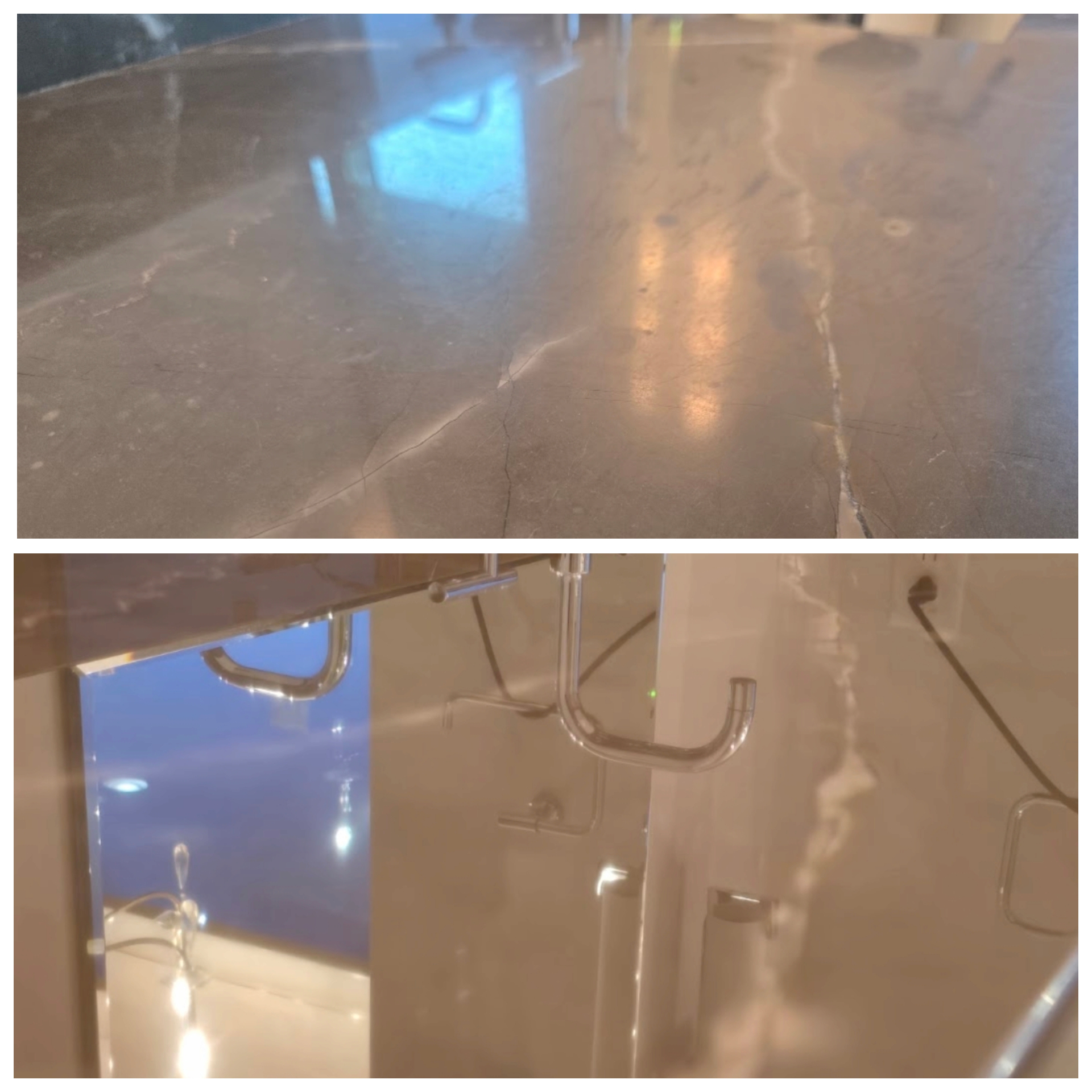
A dry comparison is more useful than a wet shine
- Remove loose grit before wiping. Use a clean cloth and a stone-compatible routine cleaner at its labeled dilution.
- Rinse when required, dry completely and inspect the same area under the same light. Water can temporarily hide a dull finish.
- Record the product name, finish, location and whether the patch changes after rinsing. Do not repeatedly scrub to “test” abrasion.
- If the dry patch remains, stop. Ask whether it is a deposit, an etched finish or a scuff before choosing polishing.
A restoration assessment should describe the finish you want to keep. Honing for a soft satin appearance and polishing for clearer reflections are different outcomes. Flattening tile edges is another operation and should not be implied by a cleaning quote. The exact abrasive sequence depends on stone condition; there is no defensible universal grit recipe for every counter or floor.
Clean, repair, protect: choose the work the surface actually needs
Lazona Tile Care starts with identifying the material and separating removable buildup from finish damage and failed joints. Cleaning removes soil; repairs address missing or unsound grout; honing and polishing address an altered stone finish. Grout color sealing restores uniform color on suitable, prepared joints. None of these steps substitutes for correcting leaks, movement or failed shower waterproofing.
Grout color sealing comes with a 15-year warranty for homeowners. It covers the color sealer, not the tile, the installation underneath or other surfaces. Commercial work is not covered by the 15-year warranty. Grout restoration coverage through the Maintenance Plan follows the written terms. It is not a promise that stone cannot scratch or etch, or that a shower cannot leak. Review the scope before choosing protection.
For homeowners in Chandler, Gilbert, Power Ranch, Trilogy at Power Ranch and Mesa, including Las Sendas, Book A Consultation for $150. An actual test spot costs $250 and is credited toward the project total if you book. Repair work starts at a $1,500 minimum day rate, with no exclusions. These photos are not assigned to any of those neighborhoods without a verified project address.
Sources and limits
- Mr. Clean product guidance: polished-surface warning and cleaner-mixing warning
- Natural Stone Institute: material differences, cleaning and surface-care guidance
- Project evidence: two owner-supplied comparison collages. No gloss units, abrasion-depth readings, product history or customer quote was supplied.