
Every facility has three floors that make or break how the building is judged: the restroom, the lobby, and if there is water on site, the pool deck. All three are grout heavy by design, with tight tile and long runs of joint that exist specifically to handle water, traffic, and drainage. That same joint is the weak point. Grout is porous cement, it sits lower than the tile, and in a commercial setting it collects everything the building produces. Once it opens up or absorbs, nightly scrubbing stops being maintenance and becomes a recurring expense that never changes the result.
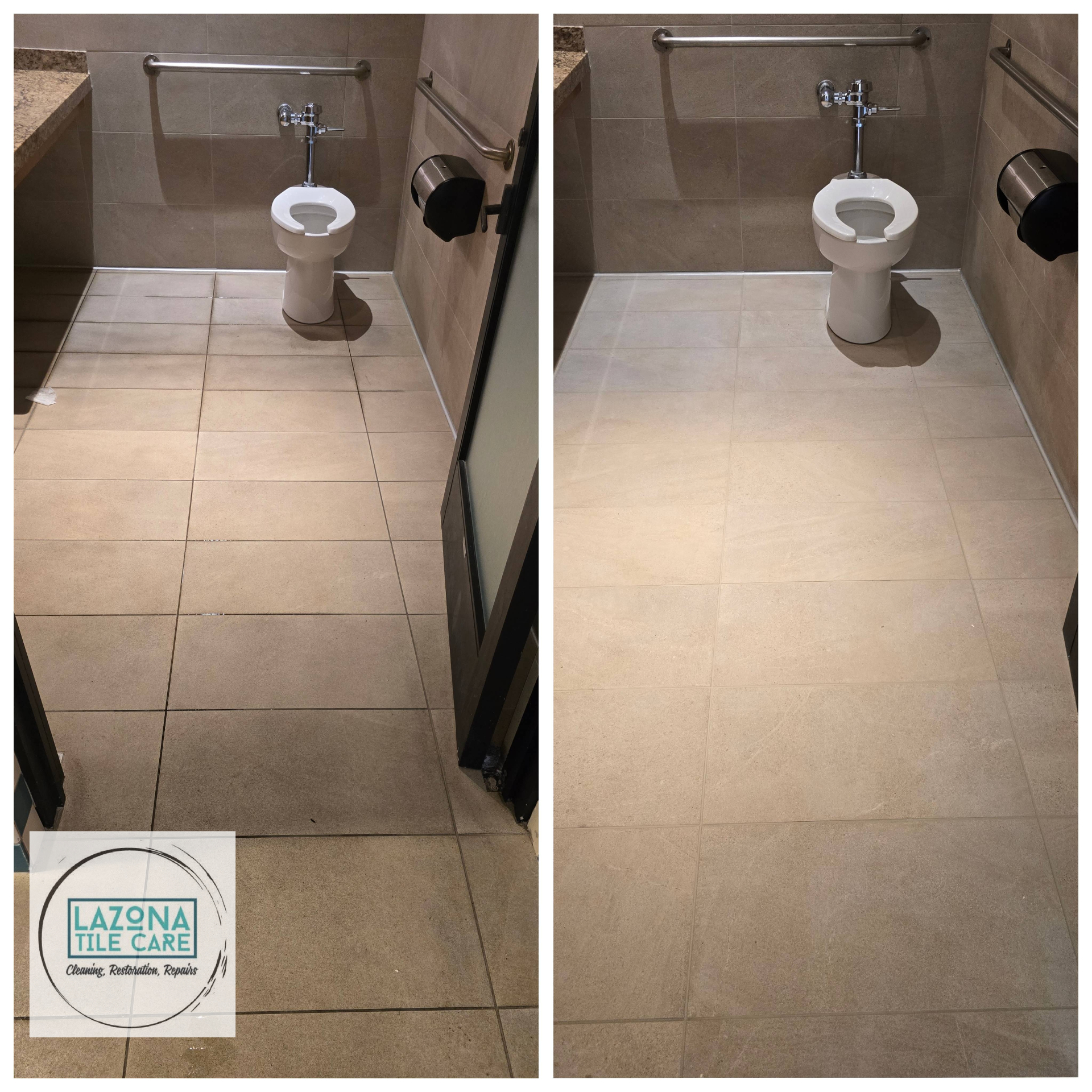
Open Grout Is Where Facility Odor Actually Lives
When a restroom smells even though it was cleaned four hours ago, the smell is almost never coming from the fixtures. It is coming from the floor, and specifically from the grout joint within about eighteen inches of each fixture and along the base of the walls. Urine wicks into open cement, dries, and leaves behind concentrated salts. Those salts are hygroscopic, meaning they pull moisture out of the air, and every time humidity rises or a mop passes over them they rehydrate and release odor again. That is why the smell returns on a cycle instead of going away.
- Grout sits recessed below the tile, so liquid runs into it by gravity and stays
- Cement grout is porous, so it absorbs rather than repels contamination
- Urine salts rehydrate with humidity and re-release odor after every cleaning
- Cracked or eroded joints create voids under the tile edge that no mop reaches
- Wet mopping spreads diluted contamination across the whole floor instead of removing it
- Deodorizers mask the release without removing the source in the joint
If a restroom passes a visual inspection but fails a smell test, stop buying stronger chemicals. You have a substrate problem in the grout joints, and chemistry applied on top of an open joint cannot fix an open joint.
Cracked Grout Hides Bacteria, and Inspectors Know Where to Look
A hairline crack in a grout joint is wide enough to hold biofilm and far too narrow for a brush bristle to enter. In restrooms, kitchens, locker rooms, and pool decks those cracks become protected reservoirs. Cleaning the surface around them looks like progress and changes nothing below. In food service and healthcare settings, open joints and voids at wall bases are one of the first things a health inspector probes, because a floor that cannot be sanitized is a floor that cannot be certified clean regardless of how it looks.
| Condition in the joint | What it causes | What it costs you |
|---|---|---|
| Absorbed urine salts near fixtures | Recurring odor hours after cleaning | Complaints, negative reviews, repeat deodorizing |
| Hairline cracks and pinholes | Protected biofilm that brushes cannot reach | Inspection findings, sanitation risk |
| Eroded joints from acidic cleaners | Loose tile edges and chipping | Tile replacement and downtime |
| Open joints at wall and base transitions | Water intrusion behind the base | Swollen baseboards, drywall damage, mold risk |
| Mineral and soap film on pool deck tile | Loss of surface traction | Slip and fall claims and liability exposure |
| Blotchy discolored grout in lobbies | Building reads dirty to every guest | Lost first impressions and lost tenants |
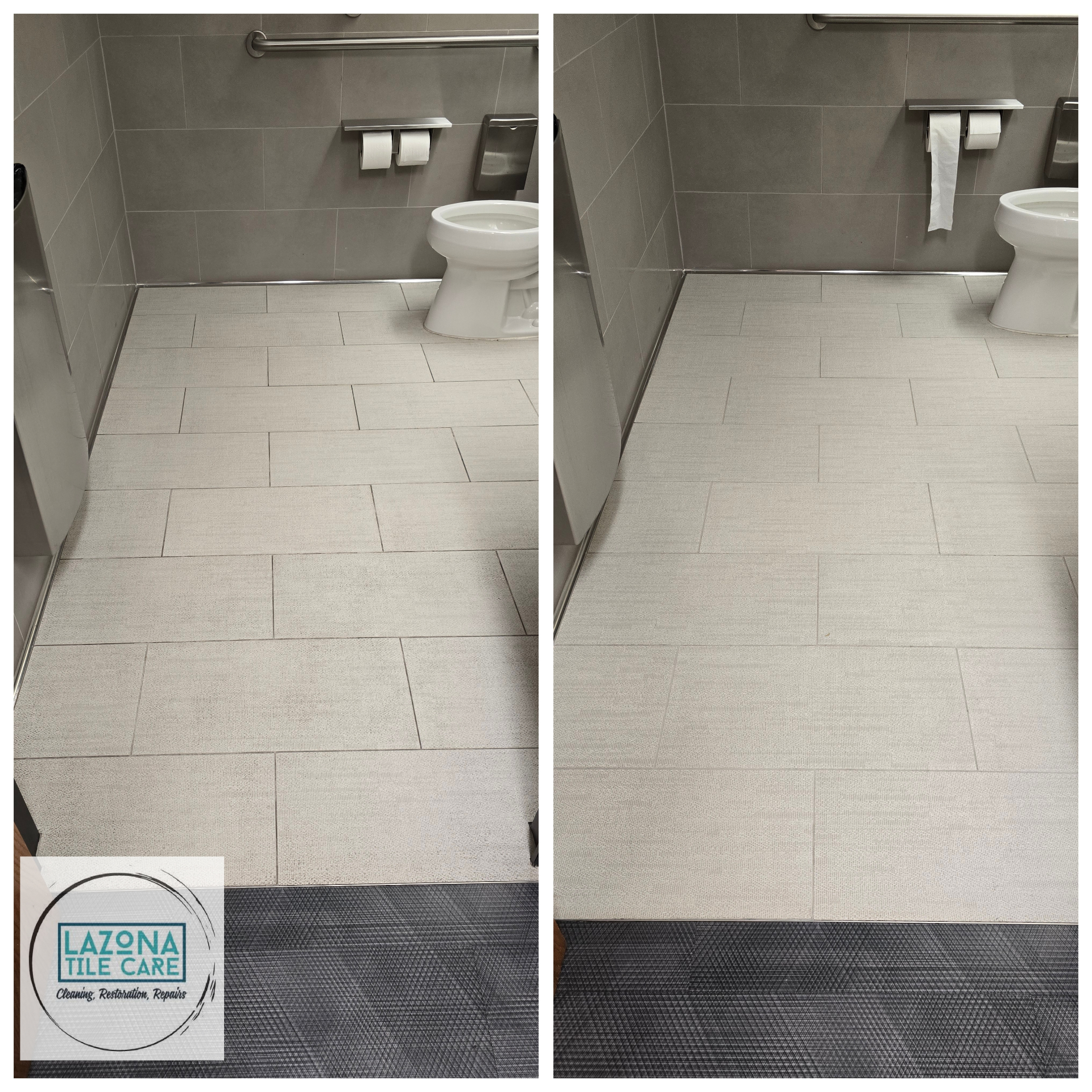
Pool Decks and Natatoriums: Traction Is the Whole Job
Indoor pool decks and natatorium walkways carry a different risk profile. Chlorinated water evaporates and leaves minerals behind, splash zones stay damp, and the textured porcelain specified for traction is exactly the surface that traps that mineral film. Over a season or two the film fills the texture, and the floor engineered to be slip resistant becomes slick when wet. Facilities respond by adding a topical coating, which fills the texture further and peels in the wet zone. The correct move is the opposite: strip the film out of the texture, repair the joints, and seal the grout so the mineral load stops rebuilding inside porous cement.
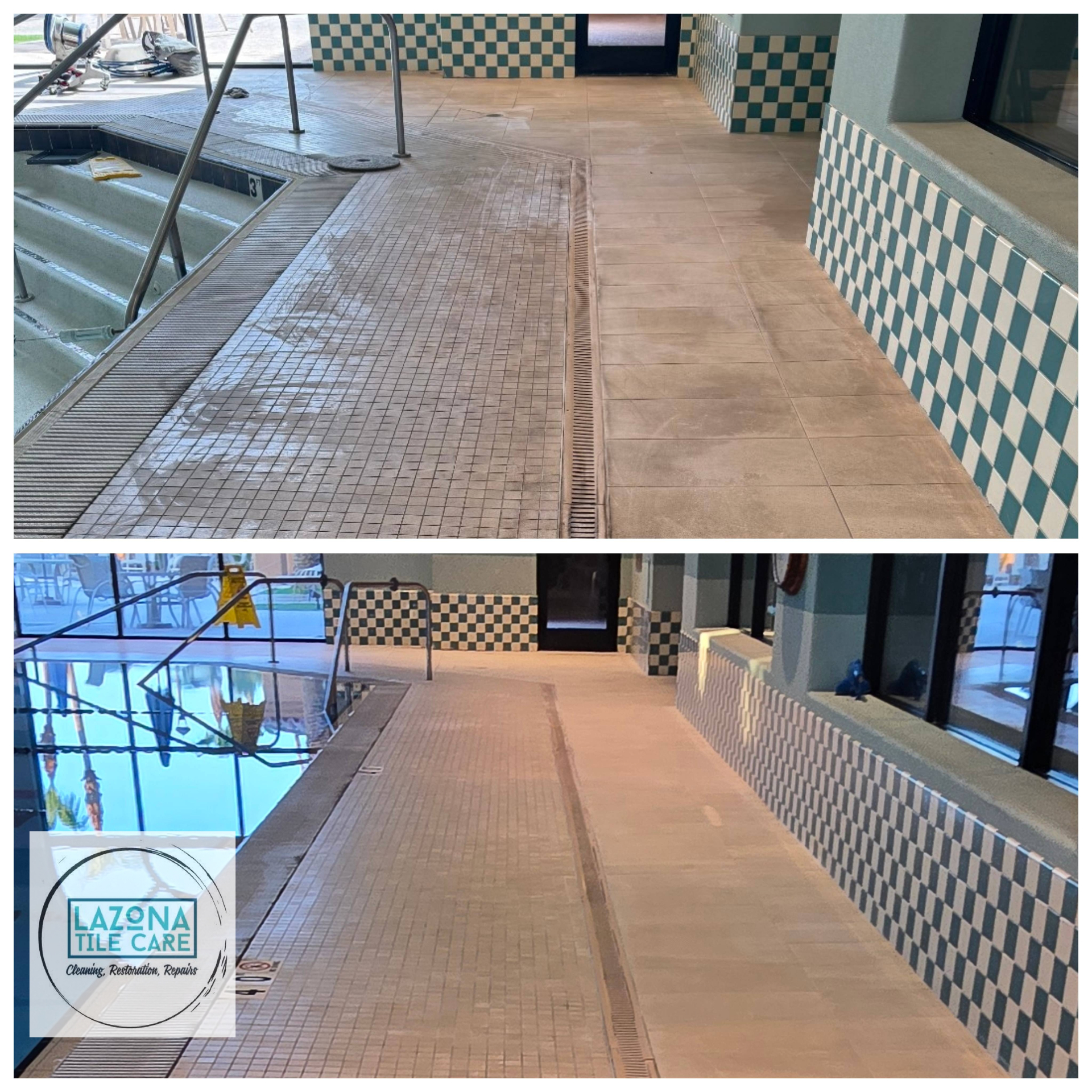
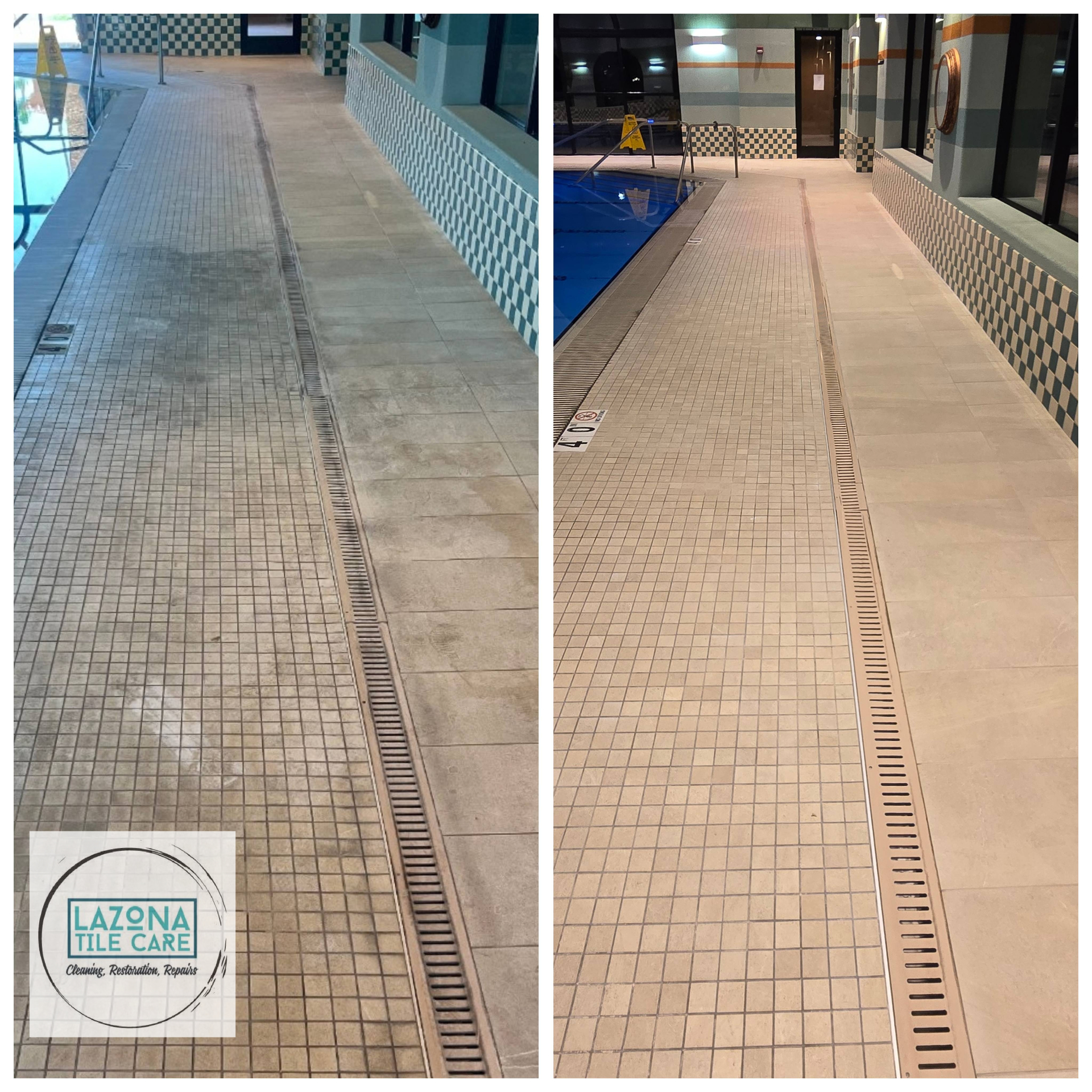
The Repair First, Seal Second Sequence We Use
Order of operations is what separates a restoration from a deep clean. Sealing over a damaged or contaminated joint locks the problem in permanently, and that is the single most common mistake we are called in to undo. We do not seal anything until the joint is sound and clean to depth.
- Documented condition survey with photos of every fixture zone, transition, crack, and void so you have a record for ownership or insurance
- Full protection of walls, bases, partitions, fixtures, and any wood or MDF, before water touches the floor
- Grout removal and regrouting where joints are cracked, eroded, hollow, or missing, including the wall base line
- Odor source treatment in fixture zones with enzymatic and alkaline chemistry given real dwell time, not a spray and wipe
- Mechanical agitation matched to the tile, then truck-mounted hot water extraction with full recovery so contaminated water leaves the building
- Mineral and film stripping inside textured porcelain so anti-slip texture is open again
- Neutral rinse, second extraction, and complete dry down before any sealer is considered
- Grout color sealing across every joint in one matched color, which pigments and encapsulates the cement in a single application
- Written scope, aftercare chemistry guidance for your janitorial team, and a scheduled follow up
A sealed and color matched joint is non-absorbent. That is the operational win: your housekeeping crew is cleaning a surface instead of trying to clean inside porous cement, so the same nightly routine produces a visibly better result with less labor.
Why Cleaning Only Keeps Failing in These Areas
Here is the analogy we use with facility managers. When you get a stain on a white uniform shirt and run it through the wash, the shirt comes out clean. It is still stained. Grout behaves exactly the same way. Scrubbing and extraction sanitize the joint and remove what sits on top, but the pigment and salts that have absorbed into the cement are not coming back out. Restoring uniform color means putting color back, and that is what a color seal does while simultaneously capping the joint against future absorption.
The alternative most facilities are sold is a clear topical sealer applied after a cleaning. It does nothing for existing discoloration, it fills anti-slip texture on deck tile, and it wears and mops away under commercial traffic, which means it needs to be reapplied on a cycle at your expense. That is the losing battle: pay for cleaning and sealing, watch it disappear, pay again, and never get a floor that presents well. Our grout color sealing carries our 15-Year Warranty, which is why our clients never pay to seal their grout again.
| Outcome | Cleaning only | Repair + color seal |
|---|---|---|
| Removes surface soil | Yes | Yes |
| Closes cracks and voids that hide bacteria | No | Yes, regrouted first |
| Eliminates recurring odor at the source | Temporarily | Yes, joint sealed and non-absorbent |
| Restores uniform joint color for presentation | No | Yes |
| Restores traction in textured deck tile | Partially | Yes, texture stripped and kept open |
| Reduces janitorial labor per night | No | Yes, less scrubbing for a better result |
| Holds up under commercial traffic | Rework on a cycle | Long term |
| Warranty | None | 15-Year Warranty |
Your Staff Has Better Things to Do Than Fight the Floor
Most janitorial teams in Arizona facilities spend a meaningful share of every shift on floors that cannot be won with a mop. That labor is not producing a clean building, it is producing a slightly less dirty version of the same floor. Once joints are repaired and sealed, that time goes back into the work guests actually notice: touch points, glass, dispensers, fixtures, detail work, and response to real messes. Nothing changes on your payroll. What changes is what the payroll produces.
- Guests judge a building by its restroom and lobby floor before they judge anything else
- Slip and fall exposure drops when residue and film are removed instead of coated over
- A documented condition and service record supports your position if a claim is ever filed
- Quarterly maintenance visits keep presentation consistent and make budgeting predictable
- Tenants and members renew in buildings that read cared for
"The floor was never the problem. The open joint was. Repair it, seal it once, and your team stops fighting a battle it cannot win."
Facility Grout Repair and Sealing Across the East Valley
We service restrooms, lobbies, corridors, locker rooms, kitchens, patios, pool decks, and natatoriums for offices, HOAs, restaurants, hotels, medical suites, schools, gyms, and multifamily properties throughout Chandler, Gilbert, Mesa, Tempe, Ahwatukee, Scottsdale, Paradise Valley, and Phoenix. Commercial tile and grout cleaning starts at $1.00 per square foot, grout color sealing carries a $750 minimum and our 15-Year Warranty, and we schedule overnight and after hours so nothing interrupts your operation. Call 480-352-0392 for a walkthrough and a documented condition report on your grout heavy areas.